Using Lean Agile and Customer Feedback to Accelerate Releases
Traditionally, companies have designed products based on what we feel people will like / want to use, spending months, sometimes years listing down features and articulating needs that have not yet been field verified.
Over the years, even successful products have prioritized complex features that hardly anybody uses over features that are more popular and bring greater value to customers. Often, ideas and concepts are tested at a stage where much of the investment, time and effort has already been committed.
What companies need is a process to validate product assumptions with real customers at an early state to pivot or persist.
Historically, most product development cycles revolved around a yearly big bang approach. Months were spent designing features without knowing “what the customers really want.” With the popularity and acceptance of Agile methodology, the industry was able to scale down from a yearly release cycle to a smaller bi-annual, quarterly, or in some cases, monthly releases. However, it still went ahead with a full module / functionality release without end customer validation.
In a typical bi-annual release, change in business requirements and other external factors result in some redundancy of features due to the long gestation period between requirement and realization.
In a quarterly release cycle, the impact is less due to a smaller gestation period. However in a dynamic business environment – three months of time, effort and cost is substantial.
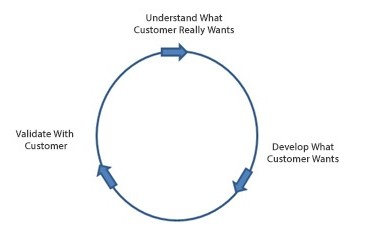
That’s where Lean Agile wins over other methodologies. It’s a process designed to create a Minimum Viable Product (MVP), which releases even the smallest chunk of code / feature for the end customers to use and validate. With timely, real customer feedback, further investment can be tailor-made to reduce waste, i.e. Money, Time and Effort.
It is all about connecting the product ideas, user experience, core engineering capabilities and data analytics into a single circular flow to give a company an edge over competitors.
Transformation Journey
Recently, Ness SES took part in the transformation of a product company’s development process from SCRUM to Lean Agile with the overarching goal of validating ideas and concepts with real customers and reducing waste. The journey was exploratory: in partnership with our customer, we all learned from feedback as we went, changed direction, recalibrated our position with respect to where we wanted to be, and redrew the plan.
We started with a simple philosophy – ideas needed to be small enough to develop within a sprint / iteration and field test with real customers. We redefined the “done” criteria for acceptance to include “Production Deployed.” This turned out to be the single biggest game changer in the overall journey. All other processes / rules / workflows were drawn to help achieve production deployment.
Monitoring changes in customer usage patterns / repeat visits for a new feature provides us with true feedback. Based on factual data, further commitments were planned and business value for a feature / functionality defined.
Our aim was to release as frequently as possible and make the release graph look like small story releases instead of features.
Team empowerment
It was clear from the beginning that a change in the team structure was necessary to support this approach, which included giving more freedom, autonomy, authority and responsibility to the SCRUM teams. Production deployment was now part of the acceptance criteria, so it was important that the team owned the last mile. Not only does the team own all stories / features and the capability to realize it, but they also help decide the future road map of the product by keeping real customer feedback at the core of the approach.
To realize this objective, all teams were realigned to have Product Owners, a SCRUM Master, Developers, Test Engineers and Hosting Resources within a team with cross-functional knowledge to support other members when needed. Functional clubs were created consisting of members with similar skills to help in cross-team pollination. Purely based on voluntary self-nominations, a team member can join a club that interests him / her the most. Cross functional teams ensured that we have a totally independent group that does not fear experimenting and validating their ideas with customers.
The Journey so Far
The journey has been revolutionary for learning more about customer behaviors and preferences every day. In the process we now have more involved customers – an inner circle who is also our most vocal advocates. They are our brand ambassadors because we listen to them and release some very interesting and cool features that they need.
Just as valuable, we have learnt about features which didn’t really excite customers, or those they perceived having no real value. In such cases, we modified the course and sometimes even abandoned the stream altogether, which saved time and ensured investment toward more productive features.
As with any other journey, it is a continuous process where we are constantly finding / experimenting with new ideas, validating with real users and continuously building products we know customers will enjoy.